Category: Strategic Architect

You aren’t just managing the office; you are Architecting the Partnership. You operate with a high degree of autonomy, making decisions that align with the long-term vision rather than just the immediate deadline.

  • The Mean Admin Club

    The Mean Admin Club

    Engineering Your Defense Against Workplace Friction

    Every master architect knows that the greatest threat to a beautifully designed structure isn’t a sudden storm—it’s internal friction.

    In the administrative profession, that friction often takes a specific, toxic form: the Mean Admin Club. These individuals rely on micro-aggressions, information hoarding, and passive-aggressive maneuvering to influence their environment. Instead of building systems and each other up, their operational goal is to keep peers off balance, emotional, and reactive.

    As a Temporal Engineer and Workflow Alchemist, you cannot allow toxic group dynamics to degrade your operational efficiency or compromise your partnership with your executive. Here is how to analyze the breakdown, audit the threat, and deploy precise countermeasures.

    The Blueprint of a Toxic Operation

    In a healthy corporate infrastructure, you might encounter one or two dysfunctional actors. When they realize their tactics fail to yield results, they move on.

    However, in a toxic environment, this behavior is tolerated or even enabled by leadership. I once navigated a highly political landscape where the old guard protected their territory through intimidation, gossip, and actively pushing back against new leaders hired to improve metrics.

    In that specific ecosystem, I encountered an admin who proudly self-identified as a difficult person. Over time, their operational flaws became obvious:

    • Information Hoarding: They refused to share best practices, opting to weaponize knowledge instead of distributing it.
    • Unreliability: They routinely dumped peer work or backed out of simple agreements, such as conference room bookings, at the last minute.
    • The Silent Treatment: when they perceived a slight—such as a peer not cleaning up a retirement party organized by their own department—they deployed weeks of complete silence rather than engaging in rational communication.

    When an administrator spends more time managing grudges than managing workflows, they become a systemic liability.

    The Diagnostic: How to Spot the Saboteur

    Let’s face it: very few bullies will announce their toxic tendencies, you must listen to their words and observe their behavior. Watch for these key indicators:

    1. Knowledge Hoarding: They view information as leverage rather than an asset to optimize team performance.
    2. Authority Bludgeoning: They use their executive’s title or their own tenure to throw weight around, frequently flying off the handle over mundane operational details.
    3. The Mirror Effect: They treat people with performative kindness to their faces, only to immediately tear down their outfits, intellect, or work product the moment they walk away.

    Operational Countermeasures: Alchemical Defenses

    When dealing with a workplace bully, your goal is simple: maintain your structural integrity and let their chaos consume them. Do not lash out. Bullies despise rational adults. Instead, deploy these four strategic workflows:

    1. Eliminate Disposable Communication

    Toxic actors prefer untraceable mediums—verbal side-chats, quick instant messages, or texts—because they hate accountability. Documentation!

    The Alchemical Rule: Always follow up disposable communication with a written email summarizing the facts, timelines, and commitments. Build a paper trail they cannot rewrite.

    2. Execute Flawless Work Product

    Your output is your shield. Execute your responsibilities to the highest standard. When your systems are sound and your logistics are flawless, a bully has zero leverage to use against you.

    3. Log the Data (Outside the Network)

    When friction occurs, perform an emotional brain dump via journaling to clear your headspace—but keep that entirely in your personal space. Afterwards, extract the objective data points: dates, times, specific actions, and business impacts. Store this factual documentation securely. If you ever need to escalate the issue to leadership or HR, you will be presenting a business case, not an emotional grievance.

    4. Minimize Contact and Stand Your Ground

    You were hired to engineer a strategic partnership with your executive, not to clear the path for a peer’s lack of accountability. Keep your interactions highly professional, brief, and anchored strictly to company templates and standard operating procedures.

    The Natural Conclusion of Entropy

    When leadership eventually holds the administrative ecosystem accountable, bad actors inevitably flame out. They will take excessive leaves of absence, amplify complaints of mistreatment, and ultimately exit the organization, often on short notice.

    When the descent begins, notice who distances themselves to save their own skin—those former co-conspirators are not your allies either.

    Protect your time, guard your energy, and keep your focus on the executive(s) you support. If the environment proves completely unfixable, use your engineered skill set to build an exit strategy to a team that values true strategic partnership.

  • The Reality of the Pendulum: It’s a Continuum, Not a Destination

    The Reality of the Pendulum: It’s a Continuum, Not a Destination

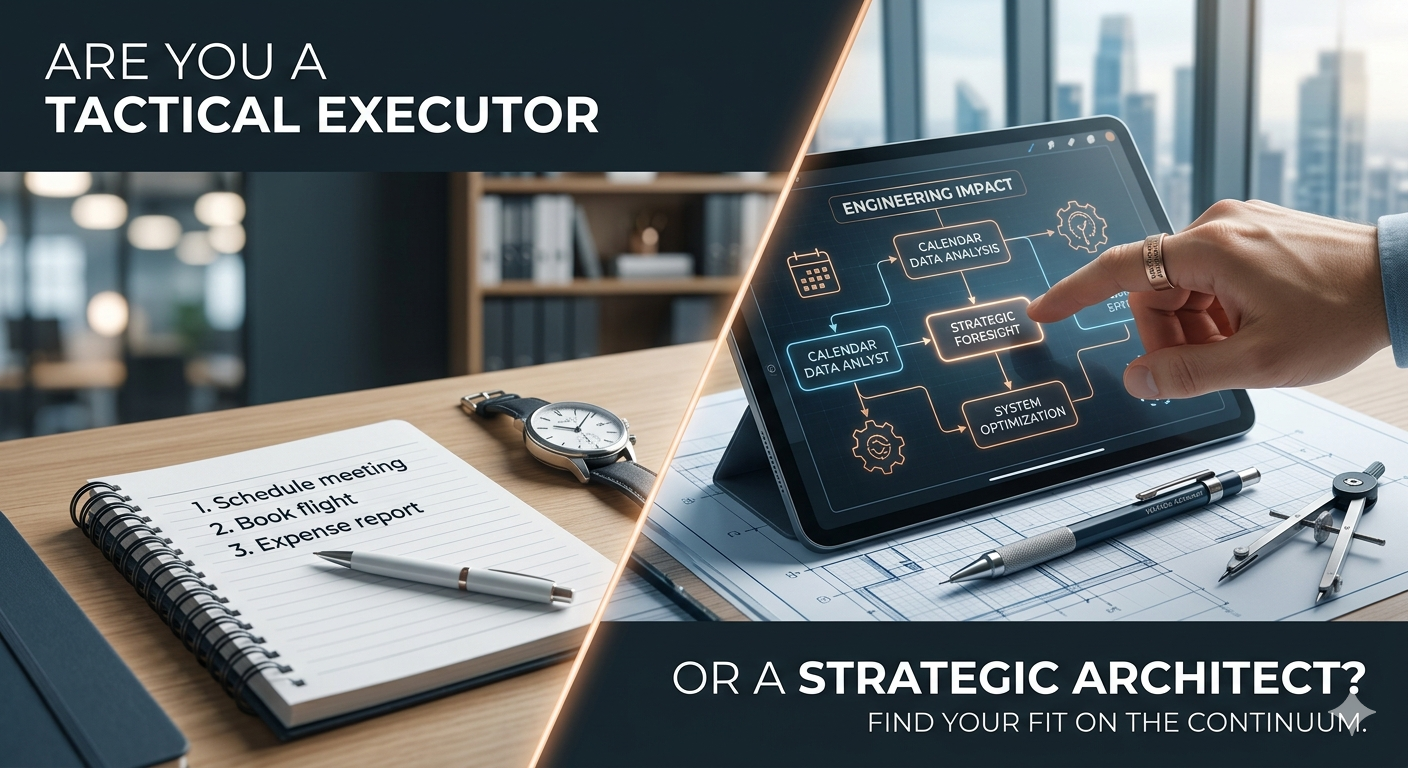
    Now, a word of EA-to-EA honesty: Strategic Partnership isn’t a permanent state of being. It’s a continuum.

    Even the most seasoned Strategic Architect has days—or months—where they have to slide back into Tactical Execution.

    • The Onboarding Phase: When your executive changes (or as I’ve experienced recently, when your second executive changes five times in a year!), you cannot be strategic on Day One. You have to focus on Structural Integrity first. You have to learn the new leader’s rhythm, their shortcuts, and their blind spots before you can start engineering their success.
    • The Capacity Check: Some days, your mental bandwidth is at zero. On those days, the most strategic thing you can do is put your head down and handle the low-key work. Clean up the calendar. Audit the travel folders. Reset the foundation.

    Strategy requires a solid base. If the base is shifting, or if your own internal battery is low, it is perfectly okay—and often necessary—to be a Tactical Executor.The goal isn’t to never do tasks; it’s to ensure that doing tasks isn’t your only mode of operation. We build the tactical foundation so that when the timing is right and the capacity is there, we have the Structural Integrity to step up as a true Co-Pilot.


    Ready to find your baseline? Complete the form below to unlock instant access to the Executive Toolkit Vault and join our inner circle. Map your operational coordinates, step out of the tactical churn, and receive our upcoming framework updates delivered straight to your control room.

  • Just Walk Out of Meeting Churn: My Journey to an AI-Powered Scheduling Pilot

    Just Walk Out of Meeting Churn: My Journey to an AI-Powered Scheduling Pilot

    We’ve all been there. You’re in a high-traffic Slack channel, and a message pops up: “Hey, Dave needs 30 minutes ASAP for a sync. Can you make it happen?” As an Executive Assistant, your brain immediately starts running a diagnostic script: What’s the goal? Who else needs to be there? Did they actually invite their own Director? What time zones are we balancing? Usually, you have to spend the next 20 minutes chasing those answers in Phone Tool or via back-and-forth pings before you even touch the calendar.

    I’ve always wanted to automate this “messy middle,” but for a long time, I thought the door was locked to me because I wasn’t a “coder.”

    The “100 Days of Code” Wall

    Three years ago, I decided to take matters into my own hands. I signed up for Replit’s 100 Days of Code. It was marketed as “easy for the inexperienced” and only required 15 minutes a day.

    For the first week, I was flying. I felt like I was finally learning the secret language of the tech world. But then came Day 16. The “15-minute” challenge turned into a two-hour battle with brackets, indentation, and cryptic error messages. My code wouldn’t run, and I couldn’t figure out why. I realized then that while I loved solving problems, I didn’t want to spend my life fighting with syntax. I put the keyboard down and went back to my manual workflows.

    The Breakthrough: Trading Syntax for Logic

    Fast forward to this year. At home, I used Gemini to help me rebuild EA Mentor when I moved it to a self-hosted WordPress site. Gemini helps me rewrite blog posts and generates summaries for my subscriber newsletters. At work, I started using Amazon Quick, an internal AI-assisted development tool. Just small tasks: draft this email, summarize this document, give me a step-by-step on this tech thing I don’t know how to do.

    At the same time, meeting requests were becoming sloppy: missing information, multiple attendee updates, requests going to the wrong EA. The EAs in my group want meeting requests sent via email but our teams work in Slack.

    I wondered if I could create an automated tool in Slack and if Quick could help me create it. But I was skeptical because I ‘failed’ learning Python.

    The process wasn’t coding—it was coaching. I engaged in a series of iterative conversations with the tool. I realized that my years of EA experience wasn’t just admin work; it was logic. I knew the if-then statements of an executive’s life better than any software engineer.

    Building the EA-Protection Layer

    Using Amazon Quick, I built an Executive Meeting Coordinator Agent that lives in Slack. Instead of a messy, five-minute typing session, the agent walks the requester through a structured interview. But I didn’t just build a form; I built logic that protects the EA’s time:

    • The Director & EA Lookup: The agent automatically pings Phone Tool to identify the requester’s Director and their assigned EA. No more “Who do I send this to?”—the agent already knows the correct routing.
    • The “Optional” Guardrail: We’ve all seen it—a requester asks for a meeting with a Director but marks that Director as Optional or leaves them off the invite entirely. My agent catches this instantly and prompts the user to correct it.
    • The Multi-Director Tiering: The agent asks the user to categorize the meeting. Is it a 1:1? Or a high-stakes sync with multiple Just Walk Out Directors? This gives the receiving EA instant context on the weight of the meeting.
    • The Global Buffer: To save me from the timezone math headache, the agent makes Time Zones to Consider a mandatory field.

    The best part? Quick wrote all the Python code, managed the Lambda configuration, and handled the Slack integration. I provided the Business Logic, and the AI provided the Technical Execution.

    The Results: The “Just Walk Out” Pilot

    The end-user experience is a seamless bridge:

    • The Requester has a private, guided conversation with the bot in a Slack DM to gather the name, length, timeframe, and attendees.
    • The EA receives a perfectly formatted, Ready-to-Schedule email in their inbox—no Slack noise, no missing info, no guesswork.

    On April 1st, we are launching a two-week pilot with our 5-person EA team. We’ll be stress-testing these rules before rolling the agent out to senior managers and eventually the entire Just Walk Out team.

    My Advice to Fellow EAs

    If you’ve ever hit a Day 16 in your life—whether it was a coding class or a complex project that felt out of reach—don’t let it stop you. The barrier to entry has moved. We are moving into an era where our domain expertise is the most valuable code there is.

    You don’t need to learn to speak Computer. You just need to learn how to teach an AI to speak EA.


    Now, I want to hear from you.

    Have you ever hit your own ‘Day 16’ wall with a technical project? Or do you have a Manual Task that’s crying out for an AI Architect?

    Drop a comment below or reply to this post—let’s brainstorm how we can turn your EA logic into your next big build.


    Technical Sidebar: The Engine Behind the Agent

    For the curious (or those who also got stuck on Day 16!), here is the plain-English breakdown of the AWS technologies used:

    • Amazon Bedrock (The Chef): This is the Artificial Intelligence. It’s the part of the brain that understands a requester’s messy Slack message and translates it into a professional email.
    • AWS Lambda (The Line Cook): This is “serverless” code. It only “wakes up” when someone pings the bot, performs the task (like looking up an EA in Phone Tool), and then turns itself off to save costs.
    • Amazon Quick (The Sous Chef): The internal tool that acted as my translator. It took my high-level instructions and wrote the actual Python code needed for the pilot.
    • Amazon SES (The Expeditor): The Simple Email Service that ensures the final request is delivered reliably to the EA’s Outlook inbox.
  • Engineering Your Strategy with SWOT

    Engineering Your Strategy with SWOT

    In the executive world, a SWOT analysis is a standard mechanism used to make informed choices for product launches or market entries. For a Temporal Engineer, this tool is a high-level diagnostic for both your career architecture and your Executive’s business landscape.

    To move from a reactive state to a proactive partnership, you must be able to audit the variables around you.

    The Mechanism: The SWOT Framework

    SWOT allows you to categorize any professional situation into four distinct quadrants:

    • Strengths and Weaknesses: These are your internal data points. When auditing your own desk, these are the skills you excel at and the gaps in your technical stack. When auditing a project, these are the resources your team possesses versus the bottlenecks holding you back.
    • Opportunities: These are external factors you can capitalize on, such as a new software rollout that could automate your Executive’s reporting or a networking event that could connect your team with a key vendor.
    • Threats: These are external barriers that could impede progress, such as an upcoming budget cut, a shift in company leadership, or a sudden change in market stability.

    The Alchemist’s Audit: Beyond the Career Pivot

    While many use SWOT for a career pivot—analyzing the risks of moving from a tech giant to a non-profit—active EAs use it daily to stay three steps ahead of the business.

    1. Project Post-Mortems

    After a major board meeting or an offsite, use SWOT to analyze what happened. What were the internal strengths that made it successful? What external threats (like a travel delay or a tech failure) almost derailed it? This data ensures the next event is even more resilient.

    2. Stakeholder Mapping

    If your Executive is entering a difficult negotiation or a cross-functional project, run a SWOT on the opposition or the other departments involved. Understanding their potential weaknesses or the external threats they are facing allows you to help your Executive prepare a more effective strategy.

    3. The Annual Performance Review

    Instead of just listing your tasks from the year, present a SWOT analysis of your role. Show your Executive that you understand the opportunities for growth in the department and that you have identified the threats to their time. This moves the conversation from “what you did” to “how you think.”

    Install the Full Strategy

    This series has explored the foundational tools every strategic partner needs to master:

    1. The Priority Matrix: To filter the noise of daily emergencies and focus on what truly moves the needle.
    2. SMART Goals: To architect specific, measurable outcomes with clear deadlines.
    3. SWOT Analysis: To make informed, high-stakes decisions for your projects and your career.

    Equip your strategic control room. Complete the form below to instantly unlock the Strategy Trio Bundle (SMART Goals, SWOT Analysis, and Priority Matrix) inside the Toolkit Vault. Three high-leverage frameworks, delivered in a single master asset.

  • Three Strategic Mechanisms for EA Leadership

    Three Strategic Mechanisms for EA Leadership

    In the traditional blueprint of an office, the Executive Assistant is often viewed solely through a tactical lens—scheduling, travel coordination, and scribing. But the role has evolved significantly. Today, a Temporal Engineer recognizes that leadership isn’t a title you are given; it’s a mechanism you install.

    You don’t need to manage a team or hold a “Lead” title to be a leader. Leadership is simply taking ownership, being proactive, and engineering outcomes that contribute to the organization’s success.

    Here are three ways to shift from tactical support to strategic leadership.

    1. Install a Strategic Mindset

    We hear the term “strategic” constantly, but in this system, it means understanding the long-term vision, goals, and objectives of your organization. You must become a diagnostic sensor for the challenges and opportunities facing your company.

    • Audit Your Knowledge: Do you know your organization’s top three products or services?
    • Seek Intelligence: Ask targeted questions to understand your leader’s specific objectives.
    • Be a Trendsetter: You have more power than you realize. If you have a big headache in your workflow, engineer a process to solve it without waiting for permission. When others see the efficiency of your new mechanism, they will adopt it.

    2. Command Ownership of Projects

    To build a high-performance career, doing the minimum is an operational failure. Leadership requires providing the value your executive didn’t even know they needed until you delivered it.

    • Exceed the Blueprint: Go beyond the expected scope to complete tasks to the absolute best of your ability.
    • Proactive Improvement: Identify stagnant processes and take the lead in implementing new initiatives.
    • Collaborative Control: Demonstrate your ability to manage projects by collaborating across departments to move the needle.

    3. Commit to Continuing Education

    In technology and in business, if you aren’t upgrading, you are becoming obsolete. I have seen countless apps like WordStar and WordPerfect vanish because they ceased to be relevant. A leader never stops learning.

    • Professional Development: Invest in yourself through conferences, workshops, and specialized training.
    • External Networking: Connect with peers outside your organization to stay ahead of industry best practices.
    • Expertise Certification: Pursue advanced degrees or certifications to verify your commitment to the profession.
    • Leverage Resources: Utilize professional organizations like IAAP, industry publications like Executive Support Magazine, or work with a coach to sharpen your edge.

    The Outcome

    By developing a strategic mindset, taking full ownership, and constantly upgrading your skills, you provide the insights and recommendations that demonstrate your true leadership potential. Stop asking for permission to lead and start engineering the success of your organization.

    Master the logic. Rule the clock.

  • Strategic Minute-Taking for Complex Subjects

    Strategic Minute-Taking for Complex Subjects

    As a Temporal Engineer, one of your most critical functions is capturing the Organizational Memory of a meeting. While note-taking is a personal diagnostic tool, Minute-Taking is a core leadership skill that transforms a chaotic discussion into a strategic record of alignment and action.

    Many EAs feel overwhelmed when dropped into meetings covering technical or complex topics that seem over their head. Early in my career at Fred Hutch, I had to record minutes for safety committees covering radiation and biohazards despite having a degree in technical theater. I learned that you don’t need to be a subject matter expert to produce high-quality minutes; you need a repeatable system.

    Here is how to engineer the narrative when the topic is complex.

    1. Pre-Flight and Post-Flight Reviews

    The Chairperson is your primary resource for ensuring accuracy. They want good minutes, so demonstrate your willingness to learn the lingo.

    • The Agenda Audit: Use the agenda as your blueprint. Meet with the Chair beforehand to understand the intended outcomes.
    • The Feedback Loop: After the meeting, clean up your draft and ask the Chair for a specific review. You will likely get acronyms or technical terms wrong at first, but this review process is how you learn.

    2. Develop Your Question Code

    Meetings move at the speed of light. Unless an item is of legal or HR importance, do not stop the flow to ask for a definition.

    • The Diagnostic Symbol: Develop a shorthand code (like a specific symbol or highlighted text) to mark areas where you need clarification later.
    • Post-Meeting Clarification: Use your code as a reminder to follow up with the Chair or a specific attendee after the session.

    3. Transcribe, Don’t Summarize (Initially)

    The most common mistake is trying to summarize complex material during the meeting. If you don’t understand the topic yet, your summary will likely be inaccurate.

    • Live Transcription: Act like a court reporter. Focus on recording the discussion verbatim where possible, ignoring grammar and formatting for the moment.
    • The Golden Window: Block 1.5–2 hours immediately after the meeting to finalize the document. The discussion is still in your short-term memory now; it may be gone by morning.

    4. Track the Action Items

    The primary function of minutes is to track group alignment and action. Without clear tasks, the meeting should have been an email.

    • Speak Up for Clarity: If an action item, owner, or deadline isn’t made clear during the discussion, this is the one time you should speak up and ask for clarification.

    5. Tactical Training

    To become a strategic partner, you must learn the language of the business.

    • Shadow the Experts: Take the same basic training courses the technical teams are required to take. It shows a sincere desire to understand the material and builds trust with your team.
    • Find a Subject Mentor: If your executive is too busy, find someone in the group who loves to “geek out” on their expertise and let them show you the ropes.

    The Outcome

    By following this system, you move from simply “taking notes” to becoming a guardian of institutional knowledge. You don’t have to start with an understanding of the topic to end with a high-quality strategic record.

    Master the logic. Rule the clock.