Category: Proactive Pratitioner

You’ve moved beyond basic execution and have started to Anticipate. You can see a collision coming a week out and you’re already redirecting traffic.

  • The Reality of the Pendulum: It’s a Continuum, Not a Destination

    The Reality of the Pendulum: It’s a Continuum, Not a Destination

    Now, a word of EA-to-EA honesty: Strategic Partnership isn’t a permanent state of being. It’s a continuum.

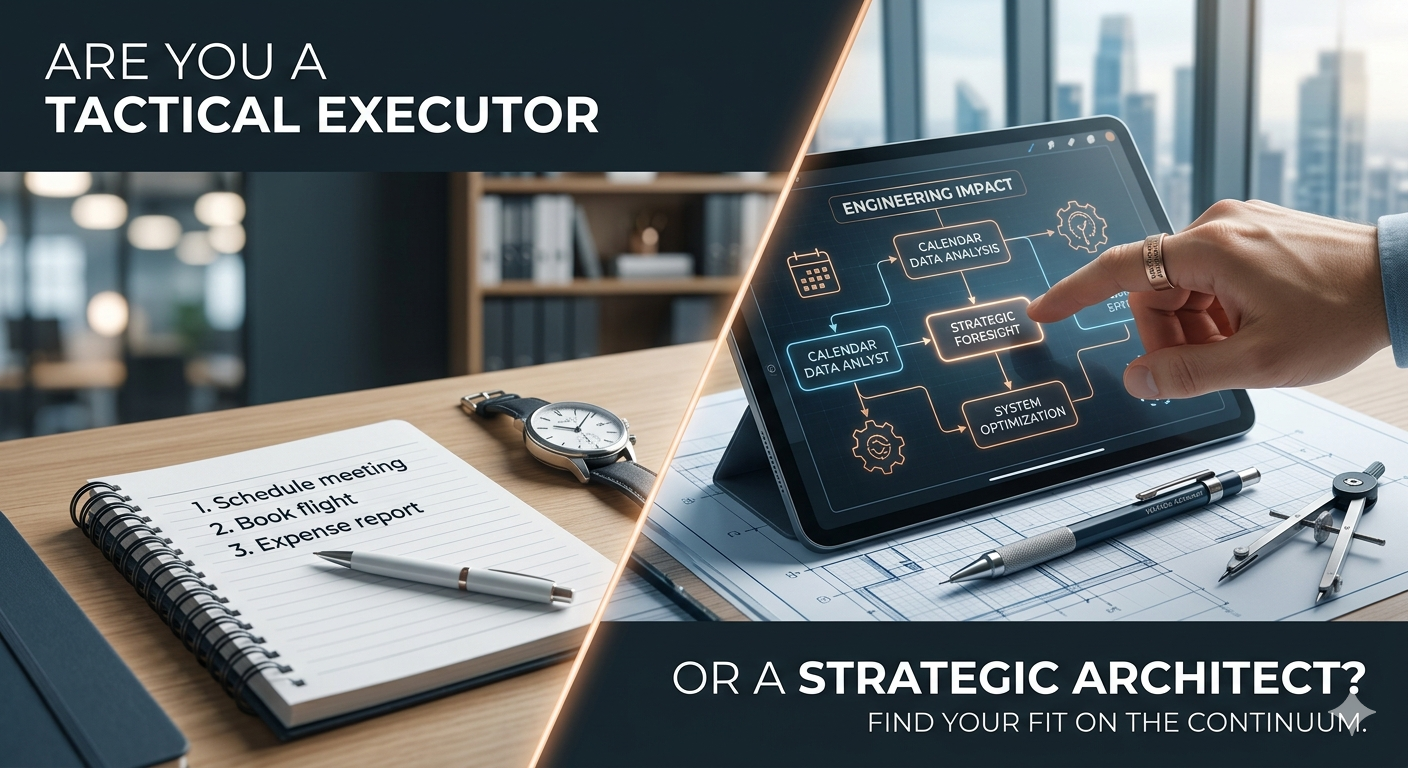
    Even the most seasoned Strategic Architect has days—or months—where they have to slide back into Tactical Execution.

    • The Onboarding Phase: When your executive changes (or as I’ve experienced recently, when your second executive changes five times in a year!), you cannot be strategic on Day One. You have to focus on Structural Integrity first. You have to learn the new leader’s rhythm, their shortcuts, and their blind spots before you can start engineering their success.
    • The Capacity Check: Some days, your mental bandwidth is at zero. On those days, the most strategic thing you can do is put your head down and handle the low-key work. Clean up the calendar. Audit the travel folders. Reset the foundation.

    Strategy requires a solid base. If the base is shifting, or if your own internal battery is low, it is perfectly okay—and often necessary—to be a Tactical Executor.The goal isn’t to never do tasks; it’s to ensure that doing tasks isn’t your only mode of operation. We build the tactical foundation so that when the timing is right and the capacity is there, we have the Structural Integrity to step up as a true Co-Pilot.


    Ready to find your baseline? Complete the form below to unlock instant access to the Executive Toolkit Vault and join our inner circle. Map your operational coordinates, step out of the tactical churn, and receive our upcoming framework updates delivered straight to your control room.

  • The Annual Cleanse: Why the Calendar Audit is an EA’s Secret Weapon

    The Annual Cleanse: Why the Calendar Audit is an EA’s Secret Weapon

    One of the most valuable contributions an EA can make is returning the gift of time to their leader. While managing a calendar often feels like a game of Tetris—simply fitting blocks where they fit—the truly strategic EA acts as a curator. This is where the Calendar Audit becomes essential.

    For an executive who owns and hosts numerous recurring meetings, attendee lists can quickly become bloated. People change roles, projects pivot, and suddenly, a lean decision-making session has transformed into a forty-person meeting. Here is how to conduct a professional audit to ensure your executive is surrounded only by the people they actually need.

    1. Establish the Accuracy Metric

    Before you touch a single invite, you must understand the why behind the meeting. Use your weekly sync to categorize your executive’s meetings into three buckets:

    • Decision-Making: Small, agile groups required to greenlight projects.
    • Information Sharing: Larger groups designed for alignment and updates.
    • Brainstorming: Creative sessions where diverse perspectives are the priority.

    Accuracy isn’t just about who is in the room; it’s about ensuring the attendees align with the meeting’s specific purpose.

    2. The Step-by-Step Audit Process

    Once you have the context, follow this systematic approach:

    • Review the Legacy List: Look at recurring meetings that have been on the books for more than 90 days. Cross-reference the attendee list with the company directory. You will likely find people who have left the department or the company entirely.
    • Analyze Attendance Patterns: Use your Contextual Intelligence during meetings. If you notice an individual has accepted but hasn’t attended or contributed in a month, they are a prime candidate for the optional list.
    • Identify the Bottlenecks: Is the meeting frequently delayed because one specific person is always late? Is it stalled because a key decision-maker is missing? Adjusting the attendee list is often the solution to these operational friction points.

    3. Executing the Soft Move

    Removing someone from a meeting invitation can be politically sensitive. As the EA, you are the enforcer of efficiency, but you must do so with diplomacy. Instead of a cold deletion, use a soft move strategy:

    • Move to Optional: Shift non-essential stakeholders to the optional category so they stay informed but aren’t required to attend.
    • The Follow-up Summary: Propose that instead of attending, certain individuals receive the meeting minutes or the Action Item summary you create. This keeps them in the loop without costing them an hour of their day.

    4. Presenting Your Findings

    Don’t make these changes in a vacuum. Present your audit to your executive during your weekly sync using data to present your observations, analysis, and recommended actions.

    Observation: “I noticed the Tuesday Sync has grown to 15 people, but only four are active contributors.”

    Analysis: “This is likely diluting the focus and making it harder for you to reach a consensus.”

    Action: “I’ve drafted a revised invite list that moves six people to ‘Optional/FYI’ and replaces the invite with a summary email. Would you like me to push this update today?”

    By auditing the calendar, you aren’t just managing a schedule; you are optimizing the organization’s most expensive resource: leadership time. When you ensure the right people are in the room, you make your executive unstoppable.

    5. Install a Governance Mechanism: The Meeting Request Template

    As a Temporal Engineer, you aren’t just a gatekeeper; you are a guardian of organizational energy. To prevent calendar creep, a repeatable mechanism forces intentionality before meetings are updated. I recommend implementing a Meeting Request Template.

    This is a one-page blueprint every requester must complete, outlining the essential architecture of the sync: the precise length, the type (is this a Status check, a Decision-making session, or purely Informational?), and a hard-line attendee list that distinguishes the Mission Critical required attendees vs the optional observers.

    Pro Tip from the Trenches: no matter how long you’ve been working with your executive, review the meeting request and attendees, then copy and paste the completed template directly into the calendar invite body.

    Pro Tip from the Trenches: Include a “Meeting Update” section in the body of the invite. I like it at the top of the invite. This acts as your temporal log—a running list of every shift in date or time, the reason for the change, and the initials of the EA who made the change. It creates an audit trail that proves your value and keeps a history of the changes for everyone involved.


    Take back command of the calendar. Complete the form below to grab the exact Meeting Request Template & Calendar Audit Framework inside the Toolkit Vault. Protect your executive’s capacity and design a proactive gatekeeping workflow.

  • New year, fresh start

    New year, fresh start

    Hello admin pros! Grab a cuppa and check out my 2026 Strategy & The Workflow Audit.

    The Messy Truth

    2025 was a whirlwind year. In total, I provided support to nine Directors and one VP, due to a team change in April. Two EAs were on mat leave for half the year. The lead EA left Amazon 2 months after I arrived. I was voluntold to be the VP’s interim EA, which lasted 5 months. In September, I transferred my VP to the new Lead EA. In November, I onboarded a new Director. In December, the EA team was restructured. At this writing, I’m supporting two Directors in very different business units.

    Additionally, Amazon announced it was deprecating Chime and Quip in favor of Office 365, SharePoint, and Zoom. There was a series of rolling corporate office team restacks from April to October, across the US and Canada.

    I use rules and various folders in Outlook to manage email. In the process of managing incoming meeting requests and emails, my system became a bloated mess. I spent far too much time searching shared drives for documents.

    The New Year Reset

    My goal was to clean up my inbox and rules during the week between Christmas and New Year’s, but a shocking number of people were working that week, all wanting new meeting series. I was able to convert my executive’s standing meetings from Chime to Zoom, but that was as far as I got.

    I created a new workflow to manage calendars for 2026 to audit existing meetings and streamline my mechanisms, and determine the value of where my leaders and I spend our time.

    Personal & Business Goals for 2026

    • Personal goal: learn French at the B2 level. This will improve my Permanent Resident application score. I’m currently around A1.
    • Work goal: Reclaim 4 hours of deep work per week. I’ve got several ideas that will greatly improve my executives’ lives.
    • EA Mentor goal: increase my subscribers by providing new EA tools and content.

    The original mission of the EA Mentor was to build my coaching business. However, since I’m unable to generate income beyond my Amazon job, I’ve re-evaluated my goals for the site. I will continue to provide a manual for making that EA work visible and strategic, sharing data-driven mechanisms and contextual intelligence case studies. Subscribers will have exclusive access to checklists and tools useful to working EAs.

    The Workflow Audit

    In 2025, my time was spent on tactical calendar management and documenting org communication. My Lead EA will ultimately determine org mechanisms. The org suffers from silos that extend from leadership to the EA team.

    In December, I handed over the Director I onboarded with another Director. I worked hard last month to earn trust with my new team, but I have a lot to learn about the business. The new Director wants a partner, so I’ll focus more on strategic work and less time on the energy-draining churn.

    Not my actual desk since I work in a paperless office; it’s how I felt at the beginning of the year.

    As for Tools, my goal is to reduce the number of apps I use to manage work and essential documents. I don’t pay for apps at work. Instead, I use what the company provides. I’ll be offloading Asana, which my current org doesn’t use. Slack is heavily used for scheduling. I find this difficult to manage and prefer email. I’m going to investigate Slack workflows and see if I can create or modify a scheduling workflow.

    What I will stop in 2026: documenting interactions with my coworkers. My Lead EA asked me to provide documentation in Q4. There is more than enough material for her to run with.

    Now it’s your turn: What is the one task you are officially firing this quarter?

    Establish your strategic baseline. Complete the form below to gain immediate access to the 2026 Audit Checklist inside the Toolkit Vault. Audit the infrastructure, clear the operational drag, and start the cycle ahead of the game.

  • Engineering Your Strategy with SWOT

    Engineering Your Strategy with SWOT

    In the executive world, a SWOT analysis is a standard mechanism used to make informed choices for product launches or market entries. For a Temporal Engineer, this tool is a high-level diagnostic for both your career architecture and your Executive’s business landscape.

    To move from a reactive state to a proactive partnership, you must be able to audit the variables around you.

    The Mechanism: The SWOT Framework

    SWOT allows you to categorize any professional situation into four distinct quadrants:

    • Strengths and Weaknesses: These are your internal data points. When auditing your own desk, these are the skills you excel at and the gaps in your technical stack. When auditing a project, these are the resources your team possesses versus the bottlenecks holding you back.
    • Opportunities: These are external factors you can capitalize on, such as a new software rollout that could automate your Executive’s reporting or a networking event that could connect your team with a key vendor.
    • Threats: These are external barriers that could impede progress, such as an upcoming budget cut, a shift in company leadership, or a sudden change in market stability.

    The Alchemist’s Audit: Beyond the Career Pivot

    While many use SWOT for a career pivot—analyzing the risks of moving from a tech giant to a non-profit—active EAs use it daily to stay three steps ahead of the business.

    1. Project Post-Mortems

    After a major board meeting or an offsite, use SWOT to analyze what happened. What were the internal strengths that made it successful? What external threats (like a travel delay or a tech failure) almost derailed it? This data ensures the next event is even more resilient.

    2. Stakeholder Mapping

    If your Executive is entering a difficult negotiation or a cross-functional project, run a SWOT on the opposition or the other departments involved. Understanding their potential weaknesses or the external threats they are facing allows you to help your Executive prepare a more effective strategy.

    3. The Annual Performance Review

    Instead of just listing your tasks from the year, present a SWOT analysis of your role. Show your Executive that you understand the opportunities for growth in the department and that you have identified the threats to their time. This moves the conversation from “what you did” to “how you think.”

    Install the Full Strategy

    This series has explored the foundational tools every strategic partner needs to master:

    1. The Priority Matrix: To filter the noise of daily emergencies and focus on what truly moves the needle.
    2. SMART Goals: To architect specific, measurable outcomes with clear deadlines.
    3. SWOT Analysis: To make informed, high-stakes decisions for your projects and your career.

    Equip your strategic control room. Complete the form below to instantly unlock the Strategy Trio Bundle (SMART Goals, SWOT Analysis, and Priority Matrix) inside the Toolkit Vault. Three high-leverage frameworks, delivered in a single master asset.

  • The Financial Aid Office Lesson

    The Financial Aid Office Lesson

    Back in college, I saw a sign behind a financial aid desk that changed my perspective on work forever. It read:

    “Your lack of planning does not constitute an emergency on my part.”

    At the time, it felt harsh. But after years in the executive suite, I realized that sign wasn’t about being rude—it was about boundaries and data.

    Every day, you are bombarded by stakeholders, vendors, and direct reports who all believe their request is the most important thing on your executive’s calendar. If you don’t have a system to filter that noise, you’ll spend 12 hours a day reacting to “emergencies” that aren’t actually important.

    To move from a calendar jockey to a Strategic Partner, you need to stop guessing and start analyzing.

    The Mechanism: The Priority Matrix

    I use the Priority Matrix to strip the emotion away from the to-do list. It’s a simple four-quadrant system that forces you to categorize tasks by Urgency and Importance.

    • High Urgency / High Importance: This is the “Engine Room.” Start here.
    • Low Urgency / Low Importance: These are “Someday Projects.” Be honest—if it stays here long enough, it’s probably not worth your time.

    I find this tool particularly valuable on Bad Brain Days—those days when you’re fighting a migraine or a lack of sleep and just need a clear map to follow. It takes the cognitive load off your shoulders and puts it onto the paper.

    Master the Strategy

    The Priority Matrix is just the first step in engineering a high-performance office. In my upcoming posts, I’ll be breaking down SMART Goals for long-term planning and SWOT Analysis for strategic decision-making.


    Equip your strategic control room. Complete the form below to instantly unlock the Strategy Trio Bundle (SMART Goals, SWOT Analysis, and Priority Matrix) inside the Toolkit Vault. Three high-leverage frameworks, delivered in a single master asset.

  • Engineering the Calendar: Strategies for the Control Freak Executive

    Engineering the Calendar: Strategies for the Control Freak Executive

    In the blueprint of a high-functioning partnership, the Executive Assistant manages the calendar. But what happens when the mechanism stalls because your executive refuses to relinquish control? This friction can lead to missed meetings, a damaged professional reputation, and a deep sense of frustration.

    At the heart of this resistance is usually a lack of trust. Perhaps they’ve been burned by an ineffective EA in the past, or they simply struggle with the Control Freak archetype. Regardless of the cause, as a Temporal Engineer, your task is to diagnose the issue and find a collaborative solution together.

    1. Initiate Clear Communication

    The first step in any system repair is direct feedback. At your next sync, discuss how this bottleneck is affecting your ability to do your job.

    Don’t just complain —bring data and solutions. Use concrete examples to illustrate the operational failure:

    • Missed Opportunities: How many meetings were missed because you couldn’t proactively resolve conflicts?
    • Team Impact: What is the hidden cost in hours the team spent preparing for meetings the leader failed to attend?
    • Reputation Audit: What feedback are you receiving from stakeholders regarding the leader’s availability?

    2. Find the Common Ground

    Once the problem is on the table, you must identify the barrier. Work together to engineer a mechanism that accommodates both of your needs.

    This is a team of two. Be willing to compromise as you develop your working style. For instance, I once supported a leader who gave me control but required a five-minute warning before every session. Initially, this was a manual burden for me , but over time, as we refined our system and trust grew, we limited those warnings only to high-stakes meetings.

    3. Peer-to-Peer Diagnostics

    If your internal efforts are failing, tap into the wider network of EAs. Every experienced admin has faced this Control Freak barrier. Seek guidance on the specific tips or creative calendar management techniques they used to successfully gain control.

    4. The Last Resort: Know When to Decommission

    If you have tried every mechanism in your toolkit and the executive still refuses to trust you, it may be time to move on. Some leaders will never value the strategic advantage an EA provides, and staying in that environment will eventually damage your performance, attitude, and reputation.

    You are likely not the first EA to hit this wall with them. Take the lessons you’ve learned about trust and calendar management and apply them to a role where your expertise is fully utilized.

    The Outcome

    Managing a calendar-clinging executive is challenging, but not impossible. Through clear communication and persistence, you can earn your leader’s trust and respect from the wider team.

    Master the logic. Rule the clock.