Category: Emerging Executor

You are the engine of the office. You are highly responsive, a master of the To-Do list, and the person everyone counts on to get it done.

  • The Architecture of Accountability

    The Architecture of Accountability

    Why Volunteering is a Binding Contract

    If you raise your hand for a project or request professional development from a senior peer, you are initializing an operational contract. When you no-show or abandon the deliverable, you aren’t just breaking a date—you are demonstrating that you cannot handle the complexity of higher-level responsibility.

    The Hook: Hand-Raisers vs. Hand-Deliverers

    In the early stages of an administrative career, project work is almost always transactional. An Emerging Executor is typically assigned projects—handed a pre-defined scope of work and told to execute. It is a necessary phase for building foundational execution skills.

    But as you evolve into a strategically-minded Temporal Engineer, the source of your projects must shift. You stop waiting for a hand-down; instead, you begin to independently audit the administrative infrastructure, identify systemic process gaps, and ideate your own solutions. Strategic EAs do not just manage projects—they create them out of a need to eliminate operational chaos.

    To be clear: no matter where you operate on this spectrum, a baseline of assigned projects will always exist out of sheer operational necessity. Whether it is navigating the strict compliance of an international visa application for your executive or coordinating a sudden office reallocation, certain tasks simply must be executed to keep the engine running. The distinction lies in what you do beyond the baseline. Are you merely executing someone else’s roadmap for your entire day, or are you actively designing your own? Moving from a purely reactive executor to a proactive temporal architect is the definitive threshold of career development.

    Before you step into any project, whether assigned or self-identified, you must audit the structural integrity of your choice. Why, exactly, are you volunteering to build this specific system? If it is out of a reactive habit to look busy, you are simply inviting entropy into your calendar.

    True workflow alchemy requires you to treat time as capital. Before initiation, look at your self-generated concept and ask: What KPI will you track, and how exactly is success measured? If you cannot quantify the ROI of your design, you cannot defend the space it occupies to leadership.

    The Breakdown: The True Cost of a No-Show

    To an Emerging Executor, a canceled meeting, a ghosted sync, or a stalled milestone feels like a minor calendar blip—perhaps even a welcome pocket of free time. But to a Temporal Engineer, a no-show is a critical structural failure. It represents a sudden, unhedged leak of organizational capital, momentum, and focus.

    When a stakeholder or peer fails to show up for an engineered timeline, the damage ripples far past the lost block on the grid. Consider a scenario that plays out in corporate offices every single day: A peer requests a full hour of your time for training on a complex operational process—like navigating an international visa application. You agree, blocking the time and spending 30 minutes beforehand digging through your files, pulling legacy links, and compiling tips to ensure a high-value session. Then, five minutes before the meeting, they cancel. The reason? They decided to pivot to other priorities, noting they managed to find the information on their own anyway.

    This leaves a glaring operational question: Why did they request your time in the first place?

    When people treat your calendar as a safety net for their own uncompleted research, they are outsourcing their labor at the expense of your efficiency. Before you simply click “Reschedule” and sweep this behavior under the rug, you must audit the true cost of the friction. Ask yourself: What is the literal total value of the human capital burned in this transaction? You didn’t just lose the hour of the meeting itself; you lost the deep-work prep time beforehand, and the mental switching costs required to refocus your brain afterward.

    Beyond the balance sheet lies the psychological cost: the erosion of professional respect. Every time an initiative suffers a last-minute ghosting, it signals that your time is a flexible buffer rather than a rigid boundary.

    Are you actively documenting these calendar leaks, or are you quietly absorbing the friction to keep the peace? If you constantly accommodate this behavior without enforcing a boundary, you aren’t being collaborative—you are subsidizing operational bankruptcy and letting others mismanage your most finite resource.

    The Architect’s Blueprint for True Ownership

    Enforcing accountability does not require corporate warfare; it requires structural integrity. When a peer or stakeholder mismanages your time, a Temporal Engineer does not complain, and they certainly do not quietly suffer. They issue a system correction.

    If a same-day cancellation is inevitable, utilizing a real-time communication channel like Slack or Teams is the logistically correct choice. The breakdown isn’t the medium; it’s the behavior. True ownership means holding others to the same rigorous standard of time management that you hold yourself to.

    When that baseline is violated, you must deliver an immediate, professional, yet unyielding feedback loop. You aren’t being difficult—you are protecting the firm’s operational velocity. The next time someone attempts to treat your calendar as a disposable resource, deploy the Three-Step Structural Correction:

    1. Acknowledge the Data: Confirm receipt of the cancellation calmly. Do not offer emotional platitudes like “No worries!” or “It’s totally fine!” It is not fine, and language like that subsidizes their bad behavior.
    2. Expose the Sunk Cost: Explicitly state the preparation and time that was allocated to support them. They need to see the invisible wake of their disruption.
    3. Establish the Future Border: Clearly define the standard for any future operational requests.

    When that peer canceled five minutes before our training session because they “figured it out on their own,” the response wasn’t a passive click of the reschedule button. The correction was direct: “I’m glad you found the data. Moving forward, please ensure you conduct that preliminary research before requesting a block on my calendar. I carved out an hour for this and spent 30 minutes pulling legacy files to prepare for you, which is now unrecoverable deep-work time. Let’s make sure we protect that runway next time.”

    It is polite. It is professional. And the underlying operational message is unmissable: Do not waste my time again.

    Audit your recent communications and ask yourself: How many times have you typed “No problem!” when a peer completely disrupted your workflow? Every time you soften a boundary to avoid a brief moment of professional discomfort, you invite further chaos into your ecosystem. True architects do not apologize for defending the structural integrity of their day.

    The Concluding Truth

    At its core, the architecture of accountability isn’t about being rigid or unyielding for the sake of it. It is about a fundamental truth that every elite Temporal Engineer eventually learns: You teach people how to treat your time.

    If you treat your calendar like a chaotic public square where anyone can drop a meeting, pivot on a whim, or outsource their basic research at the last minute, that is exactly how the organization will treat you. But when you treat your time like a finite, high-value corporate asset, you change the entire dynamic of your partnership.

    Stepping away from reflex phrases like “no worries” and stepping into firm, professional boundary-setting can feel uncomfortable at first. But true collaboration cannot exist without mutual respect for operational capacity.

    When you defend your boundaries, you aren’t slowing the team down—you are protecting the strategic velocity of the business. You are moving from a passive spectator of your day to the master architect of your impact. Lock your systems down, hold the standard high, and build an infrastructure that lasts.

    You don’t get to practice being a Strategic Partner one day when you get the right title. You practice it right now by being impeccable with your word to the peers who are trying to help you climb.

  • The Reality of the Pendulum: It’s a Continuum, Not a Destination

    The Reality of the Pendulum: It’s a Continuum, Not a Destination

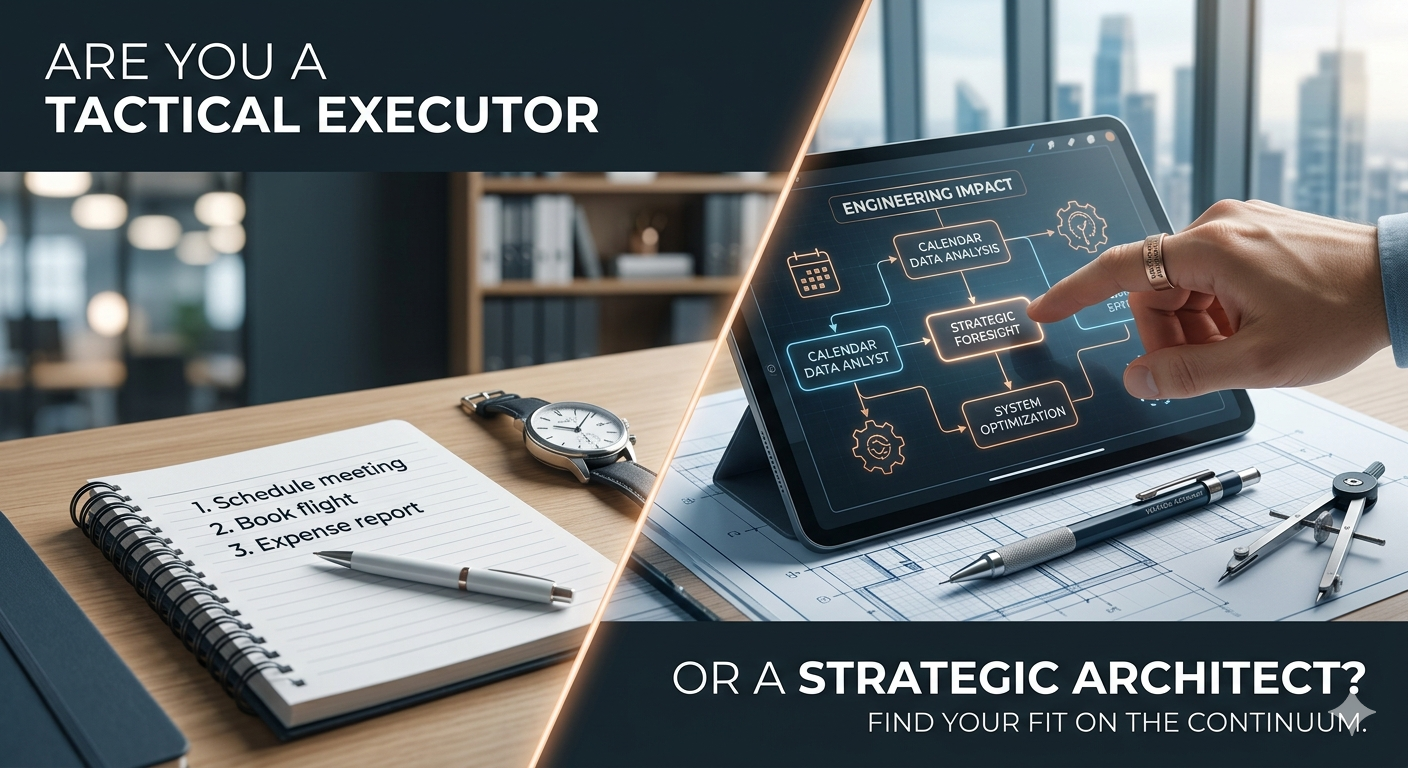
    Now, a word of EA-to-EA honesty: Strategic Partnership isn’t a permanent state of being. It’s a continuum.

    Even the most seasoned Strategic Architect has days—or months—where they have to slide back into Tactical Execution.

    • The Onboarding Phase: When your executive changes (or as I’ve experienced recently, when your second executive changes five times in a year!), you cannot be strategic on Day One. You have to focus on Structural Integrity first. You have to learn the new leader’s rhythm, their shortcuts, and their blind spots before you can start engineering their success.
    • The Capacity Check: Some days, your mental bandwidth is at zero. On those days, the most strategic thing you can do is put your head down and handle the low-key work. Clean up the calendar. Audit the travel folders. Reset the foundation.

    Strategy requires a solid base. If the base is shifting, or if your own internal battery is low, it is perfectly okay—and often necessary—to be a Tactical Executor.The goal isn’t to never do tasks; it’s to ensure that doing tasks isn’t your only mode of operation. We build the tactical foundation so that when the timing is right and the capacity is there, we have the Structural Integrity to step up as a true Co-Pilot.


    Ready to find your baseline? Complete the form below to unlock instant access to the Executive Toolkit Vault and join our inner circle. Map your operational coordinates, step out of the tactical churn, and receive our upcoming framework updates delivered straight to your control room.

  • Engineering Your First 90 Days

    Engineering Your First 90 Days

    Starting a new role as an Executive Assistant (my cheeky term is Temporal Engineer) is both exciting and high-stakes. The first 90 days are your onboarding period—the time to learn your processes, earn trust, and align with your executive’s workflow.

    Here is how to engineer a successful launch.

    Phase 1: Diagnostic & Discovery (Days 1–30)

    Your first month is about gathering data and understanding the existing architecture.

    • The Playbook Search: Identify where key documents, contacts, and historical records are kept. If a Handover Playbook doesn’t exist, start building one immediately.
    • Stakeholder Mapping: Identify the key players, proxies, and influencers within the organization. Who does your executive rely on most?
    • Calibration Syncs: Meet with your leader frequently. Ask: “How do you prefer to receive information? What are your ‘non-negotiables’ for the calendar?”

    Phase 2: System Installation (Days 31–60)

    Now that you have the data, begin implementing your strategic mechanisms.

    • Master the Calendar: Transition from simply observing the schedule to proactively defending it. Start resolving conflicts before they reach the executive.
    • Refine the Pipeline: Standardize how meeting minutes are taken and how action items are tracked.
    • The Pulse Check: Begin observing the team culture. Start reporting back factual observations to your leader to help them lead more effectively.

    Phase 3: Optimization & Branding (Days 61–90)

    By day 90, you should move from learning the system to optimizing the workflow.

    • Identify Gaps: Look for inefficiencies in the current workflow and propose updates. (e.g., “I noticed our travel booking process is manual; I’ve designed a template to streamline this.”)
    • Establish Your Brand: What do you want to be known for? Whether it’s data analysis, project management, or event orchestration, start teaching the team to fish in your area of expertise.

    The Outcome

    The first 90 days aren’t just about surviving; they are about establishing yourself as a vital component of the leadership team. By the end of this period, your onboarding is complete, and you are ready to dive deeply into your new team.

    Master the logic. Rule the clock.

  • Engineering the Narrative: The Temporal Engineer’s Guide to Strategic Note-Taking

    Engineering the Narrative: The Temporal Engineer’s Guide to Strategic Note-Taking

    Today’s mechanism focuses on a skill often dismissed as clerical, but in the hands of a Temporal Engineer, it is a high-level diagnostic tool: Note-Taking.

    While this isn’t specifically about formal meeting minutes, the practice of master-level note-taking is the foundation upon which accurate minutes are built. If you are looking for strategies on handling complex or technical meeting records, you can revisit my deep dive on that system here.

    The Memory Myth

    Early in my career—while navigating the technical complexities of Environmental Health & Safety at Fred Hutch—I realized that “learning on the job” was impossible without a rigorous documentation strategy. I had to learn biohazard and chemical safety protocols in real-time while drafting newsletters and safety manuals.

    Data shows that only 0-10% of the population possesses an eidetic or photographic memory. Statistically, you are not in that bracket.

    As Executive Assistants, we deal with a high volume of task switching and the dreaded Drive-By—those unscheduled disruptions that sever your workflow threads. Relying on memory in this environment isn’t just risky; it’s an operational failure. Note-taking is the anchor that allows you to pick up those threads instantly.

    The Anatomy of a Strategic Note

    I’ve observed that administrative professionals who fail to take notes often fall into a cycle of apologizing, repeating questions, and missing deadlines. This doesn’t just hurt productivity; it fuels Imposter Syndrome.

    To engineer a better outcome, I treat my personal notes like minutes for myself. A strategic note should:

    • Summarize Instructions: Don’t record verbatim; capture the intent.
    • Identify Critical Data: Pinpoint due dates, task owners, and stakeholders.
    • Audit Resources: Note the tools and stakeholders required to move the needle.

    The Benefits of Documentation

    • Time Conservation: Capturing details accurately the first time prevents the loop-back where both you and your executive lose time re-explaining an assignment.
    • Predictive Analysis: Over time, your notes allow you to look around corners and identify patterns that others miss.
    • Institutional Knowledge: Notes serve as a reference for rarely used processes, executive preferences, and post-event lessons learned.

    Installing Your System

    Muscle memory requires a repeatable system. Whether you prefer a physical or digital install, the key is consistency.

    Physical Systems: I began with a paper-and-pen Daily Running List, much like a Bullet Journal, transferring unfinished tasks to ensure nothing was lost.

    Digital Systems: After carpal tunnel surgery made my handwriting a creative asset but a functional liability, I moved to digital. I’ve experimented with everything from Evernote and TeuxDeux to Goodnotes.

    Currently, my primary mechanism at work is OneNote. It integrates seamlessly with the Office suite, allowing me to link meeting details directly into my minutes for a simple, all-in-one solution.

    The Experiment

    If you haven’t found your groove yet, experiment. Try one system at a time, reflect on the data of what worked, and repeat until you hit your stride. The only rule? Pick one method. If you jot a note on a Post-it, move it into your primary system immediately.

    Master the logic. Rule the clock. Stop relying on your memory and start engineering your records.

  • Engineering the Entry-Level EA: The Core Operational Mechanisms

    Engineering the Entry-Level EA: The Core Operational Mechanisms

    A standard job description often makes the Executive Assistant role sound tactical and simple. In reality, the role is a complex series of interconnected systems that require a high degree of technical and emotional intelligence to manage.

    Whether you are looking to enter the profession or want to educate your team on what you actually do, here is the blueprint for the entry-level EA skillset.

    1. The Trust Mechanism (The Foundation)

    Trust is the primary system upon which all other EA functions rely. Without it, you cannot be an effective partner.

    • System Integrity: Avoid gossip and stick to the facts at all times.
    • Reliability: Under-promise and over-deliver while consistently doing your best work.
    • Confidentiality: As the keeper of sensitive data, you must maintain absolute discretion.

    2. The Calendar & Travel Engine

    Managing time is about more than just booking slots; it is about protecting the executive’s capacity to lead.

    • Burnout Prevention: Proactively manage conflicts and ensure your leader has time for breaks, lunch, and dreaming up the Next Big Thing.
    • Global Logistics: Coordinate complex travel, including international visas, local customs, and specific leader preferences (like avoiding specific airports!).

    3. The Information & Document Pipeline

    An EA acts both as a court reporter and a librarian for the organization’s most important information.

    • Strategic Minutes: Even if you don’t understand the technical jargon at first, listen for action items, owners, and deadlines to keep the team aligned.
    • Digital Architecture: Master word processing, spreadsheets, and collaboration platforms like SharePoint or Google Drive to maintain document control.

    4. Tactical Troubleshooting & Event Management

    EAs are the boots on the ground for office operations.

    • Tech Literacy: Be prepared to troubleshoot everything from printers to the day-to-day apps.
    • Event Coordination: Manage the gears of off-sites and conferences, including catering, AV, and guest lists.
    • Space Management: Effectively manage desk and office assignments while navigating the weirdly possessive feelings people have about their workspace.

    5. The Pulse Monitor (Communication)

    You are often the bridge between the executive and the rest of the organization.

    • Internal Intelligence: Your leader relies on you to understand the pulse of the team—knowing who is dissatisfied or what the common concerns are.
    • Fact-Based Reporting: Share observations with your leader without snitching by focusing strictly on facts rather than emotions.

    The Outcome

    Being an EA is not about running errands or getting coffee—it is about exceeding expectations every day. It is a demanding role that, when engineered correctly, leads to a long and successful career.

    Master the logic. Rule the clock.

  • Engineering the Foundation: Why Trust is the Ultimate Mechanism for EAs

    Engineering the Foundation: Why Trust is the Ultimate Mechanism for EAs

    In any high-performance system, the quality of the output depends entirely on the stability of the foundation. For a Temporal Engineer, that foundation is Trust. While tactical skills like scheduling and scribing are necessary, trust is the strategic mechanism that enables you to operate at peak efficiency.

    Building trust isn’t just about your relationship with your executive; it’s about creating a network of reliability that includes their direct reports, stakeholders, business partners, and your fellow administrative professionals.

    Here is how a high-trust environment functions as a force multiplier for your career.

    The Mechanics of a High-Trust System

    When trust is successfully installed across your professional network, it activates four critical operational benefits:

    • Open Communication: In a high-trust environment, team members feel safe sharing ideas, feedback, and diverse opinions without fear. This leads to superior decision-making because all viewpoints are evaluated openly.
    • Fluid Collaboration: Trust allows team members to prioritize the success of the organization over individual interests. The result is a more productive and efficient work environment where everyone moves toward a common goal.
    • Increased Accountability: When trust exists, peers hold each other accountable for their responsibilities. This creates a culture of ownership where every team member is invested in the final outcome.
    • External Reliability: Trust extends beyond internal teams to clients and customers. When they trust that the business will deliver on its promises, it leads to long-term relationships and increased revenue.

    The High Cost of System Failure

    Losing trust is perhaps the most significant hurdle an EA can face. When the trust mechanism fails, the damage is widespread:

    • Reputational Damage: Your professional standing within the organization is compromised.
    • Operational Workarounds: Coworkers will begin to work around you rather than with you, making your role obsolete.
    • Inefficiency: Your ability to do your job effectively disappears when you are no longer the trusted gatekeeper of information.

    Installing Trust: A Consistent Effort

    Trust is not a one-time task you check off; it is a mechanism that requires constant attention. It requires:

    • Consistency: Being reliable in every interaction over time.
    • Transparency: Communicating honestly and following through on every commitment.
    • Integrity: Having the willingness to admit mistakes and take full responsibility for them.

    The Outcome

    Earning and maintaining trust is the highest priority for any executive assistant aiming to be a strategic partner. By building this foundation, you ensure that every other mechanism in your toolkit—from calendar management to project ownership—operates without friction.

    Master the logic. Rule the clock.