Author: Anne Thompson

  • The Strategic EA: Navigating the Pros and Cons of an Internal Transfer

    The Strategic EA: Navigating the Pros and Cons of an Internal Transfer

    If things have been a bit quiet around here since June, it’s for a very good reason: I was in the middle of a job transition! Moving between roles in a fast-paced environment reminded me of the unique dynamics, hidden opportunities, and subtle risks involved in an internal transfer.

    For Executive Assistants, transferring to a new division or executive within the same organization is often viewed as a “safe” move compared to changing companies entirely. However, shifting your seat at the table brings distinct advantages and trade-offs worth evaluating.

    The Pros: Sharpening Your Edge and Expanding Reach

    • Broadening Business Acumen: Moving to a new department forces you to learn a completely different aspect of the company’s core business, turning you into a far more versatile and strategic partner.
    • Expanding Your Internal Network: An EA’s influence relies on relationships. An internal shift instantly multiplies your cross-functional reach and visibility across leadership teams.
    • Refreshing Tactical Skills: For seasoned EAs, long tenure in a comfortable role can occasionally lead to autopilot mode. Stepping into a new team forces you to brush up on core tactical mechanics, workflows, and tools, breaking you out of “getting by” territory.
    • Breaking Free from Over-Dependency: Highly loyal EAs sometimes attach their entire career trajectory to a single executive. While strong alignment is valuable, it carries risk if that leader departs or transfers unexpectedly. An internal move allows you to build an independent, resilient reputation within the company.

    The Cons: Heavy Lift and Perception Risks

    • High Initial Cognitive Load: While you may already know where the coffee machine is, learning new executive preferences, team dynamics, acronyms, and business priorities takes a significant mental toll during the first 90 days.
    • The “Job-Hopper” Perception: If internal moves happen too frequently, it can raise subtle flags—causing others to wonder if the moves stem from performance issues or an inability to navigate a tough team culture.
    • Re-establishing Trust: You leave behind the deep, implicit trust built with your previous executive and start from square one to prove your reliability and strategic rhythm to a new leader.

    The Takeaway

    An internal transfer isn’t just a lateral shift; it’s a powerful tool for career longevity. When done intentionally, it allows you to diversify your business knowledge, stretch your operational muscles, and build a career anchored in your own value—not just your alignment with a single leader.

    Have you ever made an internal transfer as an EA? What was the biggest surprise for you during the transition? Drop a comment and share your experience.

  • The Architecture of Accountability

    The Architecture of Accountability

    Why Volunteering is a Binding Contract

    If you raise your hand for a project or request professional development from a senior peer, you are initializing an operational contract. When you no-show or abandon the deliverable, you aren’t just breaking a date—you are demonstrating that you cannot handle the complexity of higher-level responsibility.

    The Hook: Hand-Raisers vs. Hand-Deliverers

    In the early stages of an administrative career, project work is almost always transactional. An Emerging Executor is typically assigned projects—handed a pre-defined scope of work and told to execute. It is a necessary phase for building foundational execution skills.

    But as you evolve into a strategically-minded Temporal Engineer, the source of your projects must shift. You stop waiting for a hand-down; instead, you begin to independently audit the administrative infrastructure, identify systemic process gaps, and ideate your own solutions. Strategic EAs do not just manage projects—they create them out of a need to eliminate operational chaos.

    To be clear: no matter where you operate on this spectrum, a baseline of assigned projects will always exist out of sheer operational necessity. Whether it is navigating the strict compliance of an international visa application for your executive or coordinating a sudden office reallocation, certain tasks simply must be executed to keep the engine running. The distinction lies in what you do beyond the baseline. Are you merely executing someone else’s roadmap for your entire day, or are you actively designing your own? Moving from a purely reactive executor to a proactive temporal architect is the definitive threshold of career development.

    Before you step into any project, whether assigned or self-identified, you must audit the structural integrity of your choice. Why, exactly, are you volunteering to build this specific system? If it is out of a reactive habit to look busy, you are simply inviting entropy into your calendar.

    True workflow alchemy requires you to treat time as capital. Before initiation, look at your self-generated concept and ask: What KPI will you track, and how exactly is success measured? If you cannot quantify the ROI of your design, you cannot defend the space it occupies to leadership.

    The Breakdown: The True Cost of a No-Show

    To an Emerging Executor, a canceled meeting, a ghosted sync, or a stalled milestone feels like a minor calendar blip—perhaps even a welcome pocket of free time. But to a Temporal Engineer, a no-show is a critical structural failure. It represents a sudden, unhedged leak of organizational capital, momentum, and focus.

    When a stakeholder or peer fails to show up for an engineered timeline, the damage ripples far past the lost block on the grid. Consider a scenario that plays out in corporate offices every single day: A peer requests a full hour of your time for training on a complex operational process—like navigating an international visa application. You agree, blocking the time and spending 30 minutes beforehand digging through your files, pulling legacy links, and compiling tips to ensure a high-value session. Then, five minutes before the meeting, they cancel. The reason? They decided to pivot to other priorities, noting they managed to find the information on their own anyway.

    This leaves a glaring operational question: Why did they request your time in the first place?

    When people treat your calendar as a safety net for their own uncompleted research, they are outsourcing their labor at the expense of your efficiency. Before you simply click “Reschedule” and sweep this behavior under the rug, you must audit the true cost of the friction. Ask yourself: What is the literal total value of the human capital burned in this transaction? You didn’t just lose the hour of the meeting itself; you lost the deep-work prep time beforehand, and the mental switching costs required to refocus your brain afterward.

    Beyond the balance sheet lies the psychological cost: the erosion of professional respect. Every time an initiative suffers a last-minute ghosting, it signals that your time is a flexible buffer rather than a rigid boundary.

    Are you actively documenting these calendar leaks, or are you quietly absorbing the friction to keep the peace? If you constantly accommodate this behavior without enforcing a boundary, you aren’t being collaborative—you are subsidizing operational bankruptcy and letting others mismanage your most finite resource.

    The Architect’s Blueprint for True Ownership

    Enforcing accountability does not require corporate warfare; it requires structural integrity. When a peer or stakeholder mismanages your time, a Temporal Engineer does not complain, and they certainly do not quietly suffer. They issue a system correction.

    If a same-day cancellation is inevitable, utilizing a real-time communication channel like Slack or Teams is the logistically correct choice. The breakdown isn’t the medium; it’s the behavior. True ownership means holding others to the same rigorous standard of time management that you hold yourself to.

    When that baseline is violated, you must deliver an immediate, professional, yet unyielding feedback loop. You aren’t being difficult—you are protecting the firm’s operational velocity. The next time someone attempts to treat your calendar as a disposable resource, deploy the Three-Step Structural Correction:

    1. Acknowledge the Data: Confirm receipt of the cancellation calmly. Do not offer emotional platitudes like “No worries!” or “It’s totally fine!” It is not fine, and language like that subsidizes their bad behavior.
    2. Expose the Sunk Cost: Explicitly state the preparation and time that was allocated to support them. They need to see the invisible wake of their disruption.
    3. Establish the Future Border: Clearly define the standard for any future operational requests.

    When that peer canceled five minutes before our training session because they “figured it out on their own,” the response wasn’t a passive click of the reschedule button. The correction was direct: “I’m glad you found the data. Moving forward, please ensure you conduct that preliminary research before requesting a block on my calendar. I carved out an hour for this and spent 30 minutes pulling legacy files to prepare for you, which is now unrecoverable deep-work time. Let’s make sure we protect that runway next time.”

    It is polite. It is professional. And the underlying operational message is unmissable: Do not waste my time again.

    Audit your recent communications and ask yourself: How many times have you typed “No problem!” when a peer completely disrupted your workflow? Every time you soften a boundary to avoid a brief moment of professional discomfort, you invite further chaos into your ecosystem. True architects do not apologize for defending the structural integrity of their day.

    The Concluding Truth

    At its core, the architecture of accountability isn’t about being rigid or unyielding for the sake of it. It is about a fundamental truth that every elite Temporal Engineer eventually learns: You teach people how to treat your time.

    If you treat your calendar like a chaotic public square where anyone can drop a meeting, pivot on a whim, or outsource their basic research at the last minute, that is exactly how the organization will treat you. But when you treat your time like a finite, high-value corporate asset, you change the entire dynamic of your partnership.

    Stepping away from reflex phrases like “no worries” and stepping into firm, professional boundary-setting can feel uncomfortable at first. But true collaboration cannot exist without mutual respect for operational capacity.

    When you defend your boundaries, you aren’t slowing the team down—you are protecting the strategic velocity of the business. You are moving from a passive spectator of your day to the master architect of your impact. Lock your systems down, hold the standard high, and build an infrastructure that lasts.

    You don’t get to practice being a Strategic Partner one day when you get the right title. You practice it right now by being impeccable with your word to the peers who are trying to help you climb.


  • The Reality of the Pendulum: It’s a Continuum, Not a Destination

    The Reality of the Pendulum: It’s a Continuum, Not a Destination

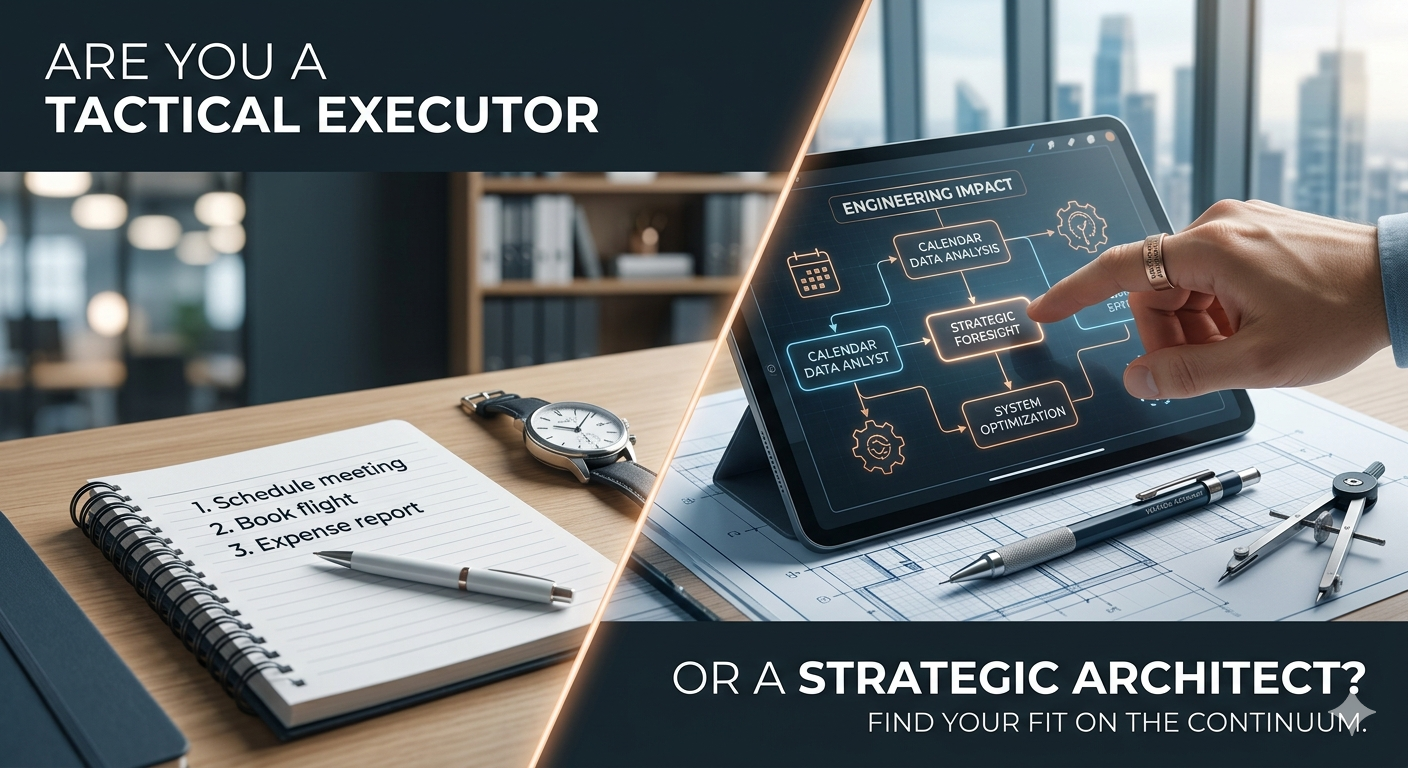
    Now, a word of EA-to-EA honesty: Strategic Partnership isn’t a permanent state of being. It’s a continuum.

    Even the most seasoned Strategic Architect has days—or months—where they have to slide back into Tactical Execution.

    • The Onboarding Phase: When your executive changes (or as I’ve experienced recently, when your second executive changes five times in a year!), you cannot be strategic on Day One. You have to focus on Structural Integrity first. You have to learn the new leader’s rhythm, their shortcuts, and their blind spots before you can start engineering their success.
    • The Capacity Check: Some days, your mental bandwidth is at zero. On those days, the most strategic thing you can do is put your head down and handle the low-key work. Clean up the calendar. Audit the travel folders. Reset the foundation.

    Strategy requires a solid base. If the base is shifting, or if your own internal battery is low, it is perfectly okay—and often necessary—to be a Tactical Executor.The goal isn’t to never do tasks; it’s to ensure that doing tasks isn’t your only mode of operation. We build the tactical foundation so that when the timing is right and the capacity is there, we have the Structural Integrity to step up as a true Co-Pilot.


    Ready to find your baseline? Complete the form below to unlock instant access to the Executive Toolkit Vault and join our inner circle. Map your operational coordinates, step out of the tactical churn, and receive our upcoming framework updates delivered straight to your control room.

  • Just Walk Out of Meeting Churn: My Journey to an AI-Powered Scheduling Pilot

    Just Walk Out of Meeting Churn: My Journey to an AI-Powered Scheduling Pilot

    We’ve all been there. You’re in a high-traffic Slack channel, and a message pops up: “Hey, Dave needs 30 minutes ASAP for a sync. Can you make it happen?” As an Executive Assistant, your brain immediately starts running a diagnostic script: What’s the goal? Who else needs to be there? Did they actually invite their own Director? What time zones are we balancing? Usually, you have to spend the next 20 minutes chasing those answers in Phone Tool or via back-and-forth pings before you even touch the calendar.

    I’ve always wanted to automate this “messy middle,” but for a long time, I thought the door was locked to me because I wasn’t a “coder.”

    The “100 Days of Code” Wall

    Three years ago, I decided to take matters into my own hands. I signed up for Replit’s 100 Days of Code. It was marketed as “easy for the inexperienced” and only required 15 minutes a day.

    For the first week, I was flying. I felt like I was finally learning the secret language of the tech world. But then came Day 16. The “15-minute” challenge turned into a two-hour battle with brackets, indentation, and cryptic error messages. My code wouldn’t run, and I couldn’t figure out why. I realized then that while I loved solving problems, I didn’t want to spend my life fighting with syntax. I put the keyboard down and went back to my manual workflows.

    The Breakthrough: Trading Syntax for Logic

    Fast forward to this year. At home, I used Gemini to help me rebuild EA Mentor when I moved it to a self-hosted WordPress site. Gemini helps me rewrite blog posts and generates summaries for my subscriber newsletters. At work, I started using Amazon Quick, an internal AI-assisted development tool. Just small tasks: draft this email, summarize this document, give me a step-by-step on this tech thing I don’t know how to do.

    At the same time, meeting requests were becoming sloppy: missing information, multiple attendee updates, requests going to the wrong EA. The EAs in my group want meeting requests sent via email but our teams work in Slack.

    I wondered if I could create an automated tool in Slack and if Quick could help me create it. But I was skeptical because I ‘failed’ learning Python.

    The process wasn’t coding—it was coaching. I engaged in a series of iterative conversations with the tool. I realized that my years of EA experience wasn’t just admin work; it was logic. I knew the if-then statements of an executive’s life better than any software engineer.

    Building the EA-Protection Layer

    Using Amazon Quick, I built an Executive Meeting Coordinator Agent that lives in Slack. Instead of a messy, five-minute typing session, the agent walks the requester through a structured interview. But I didn’t just build a form; I built logic that protects the EA’s time:

    • The Director & EA Lookup: The agent automatically pings Phone Tool to identify the requester’s Director and their assigned EA. No more “Who do I send this to?”—the agent already knows the correct routing.
    • The “Optional” Guardrail: We’ve all seen it—a requester asks for a meeting with a Director but marks that Director as Optional or leaves them off the invite entirely. My agent catches this instantly and prompts the user to correct it.
    • The Multi-Director Tiering: The agent asks the user to categorize the meeting. Is it a 1:1? Or a high-stakes sync with multiple Just Walk Out Directors? This gives the receiving EA instant context on the weight of the meeting.
    • The Global Buffer: To save me from the timezone math headache, the agent makes Time Zones to Consider a mandatory field.

    The best part? Quick wrote all the Python code, managed the Lambda configuration, and handled the Slack integration. I provided the Business Logic, and the AI provided the Technical Execution.

    The Results: The “Just Walk Out” Pilot

    The end-user experience is a seamless bridge:

    • The Requester has a private, guided conversation with the bot in a Slack DM to gather the name, length, timeframe, and attendees.
    • The EA receives a perfectly formatted, Ready-to-Schedule email in their inbox—no Slack noise, no missing info, no guesswork.

    On April 1st, we are launching a two-week pilot with our 5-person EA team. We’ll be stress-testing these rules before rolling the agent out to senior managers and eventually the entire Just Walk Out team.

    My Advice to Fellow EAs

    If you’ve ever hit a Day 16 in your life—whether it was a coding class or a complex project that felt out of reach—don’t let it stop you. The barrier to entry has moved. We are moving into an era where our domain expertise is the most valuable code there is.

    You don’t need to learn to speak Computer. You just need to learn how to teach an AI to speak EA.


    Now, I want to hear from you.

    Have you ever hit your own ‘Day 16’ wall with a technical project? Or do you have a Manual Task that’s crying out for an AI Architect?

    Drop a comment below or reply to this post—let’s brainstorm how we can turn your EA logic into your next big build.


    Technical Sidebar: The Engine Behind the Agent

    For the curious (or those who also got stuck on Day 16!), here is the plain-English breakdown of the AWS technologies used:

    • Amazon Bedrock (The Chef): This is the Artificial Intelligence. It’s the part of the brain that understands a requester’s messy Slack message and translates it into a professional email.
    • AWS Lambda (The Line Cook): This is “serverless” code. It only “wakes up” when someone pings the bot, performs the task (like looking up an EA in Phone Tool), and then turns itself off to save costs.
    • Amazon Quick (The Sous Chef): The internal tool that acted as my translator. It took my high-level instructions and wrote the actual Python code needed for the pilot.
    • Amazon SES (The Expeditor): The Simple Email Service that ensures the final request is delivered reliably to the EA’s Outlook inbox.
  • The Annual Cleanse: Why the Calendar Audit is an EA’s Secret Weapon

    The Annual Cleanse: Why the Calendar Audit is an EA’s Secret Weapon

    One of the most valuable contributions an EA can make is returning the gift of time to their leader. While managing a calendar often feels like a game of Tetris—simply fitting blocks where they fit—the truly strategic EA acts as a curator. This is where the Calendar Audit becomes essential.

    For an executive who owns and hosts numerous recurring meetings, attendee lists can quickly become bloated. People change roles, projects pivot, and suddenly, a lean decision-making session has transformed into a forty-person meeting. Here is how to conduct a professional audit to ensure your executive is surrounded only by the people they actually need.

    1. Establish the Accuracy Metric

    Before you touch a single invite, you must understand the why behind the meeting. Use your weekly sync to categorize your executive’s meetings into three buckets:

    • Decision-Making: Small, agile groups required to greenlight projects.
    • Information Sharing: Larger groups designed for alignment and updates.
    • Brainstorming: Creative sessions where diverse perspectives are the priority.

    Accuracy isn’t just about who is in the room; it’s about ensuring the attendees align with the meeting’s specific purpose.

    2. The Step-by-Step Audit Process

    Once you have the context, follow this systematic approach:

    • Review the Legacy List: Look at recurring meetings that have been on the books for more than 90 days. Cross-reference the attendee list with the company directory. You will likely find people who have left the department or the company entirely.
    • Analyze Attendance Patterns: Use your Contextual Intelligence during meetings. If you notice an individual has accepted but hasn’t attended or contributed in a month, they are a prime candidate for the optional list.
    • Identify the Bottlenecks: Is the meeting frequently delayed because one specific person is always late? Is it stalled because a key decision-maker is missing? Adjusting the attendee list is often the solution to these operational friction points.

    3. Executing the Soft Move

    Removing someone from a meeting invitation can be politically sensitive. As the EA, you are the enforcer of efficiency, but you must do so with diplomacy. Instead of a cold deletion, use a soft move strategy:

    • Move to Optional: Shift non-essential stakeholders to the optional category so they stay informed but aren’t required to attend.
    • The Follow-up Summary: Propose that instead of attending, certain individuals receive the meeting minutes or the Action Item summary you create. This keeps them in the loop without costing them an hour of their day.

    4. Presenting Your Findings

    Don’t make these changes in a vacuum. Present your audit to your executive during your weekly sync using data to present your observations, analysis, and recommended actions.

    Observation: “I noticed the Tuesday Sync has grown to 15 people, but only four are active contributors.”

    Analysis: “This is likely diluting the focus and making it harder for you to reach a consensus.”

    Action: “I’ve drafted a revised invite list that moves six people to ‘Optional/FYI’ and replaces the invite with a summary email. Would you like me to push this update today?”

    By auditing the calendar, you aren’t just managing a schedule; you are optimizing the organization’s most expensive resource: leadership time. When you ensure the right people are in the room, you make your executive unstoppable.

    5. Install a Governance Mechanism: The Meeting Request Template

    As a Temporal Engineer, you aren’t just a gatekeeper; you are a guardian of organizational energy. To prevent calendar creep, a repeatable mechanism forces intentionality before meetings are updated. I recommend implementing a Meeting Request Template.

    This is a one-page blueprint every requester must complete, outlining the essential architecture of the sync: the precise length, the type (is this a Status check, a Decision-making session, or purely Informational?), and a hard-line attendee list that distinguishes the Mission Critical required attendees vs the optional observers.

    Pro Tip from the Trenches: no matter how long you’ve been working with your executive, review the meeting request and attendees, then copy and paste the completed template directly into the calendar invite body.

    Pro Tip from the Trenches: Include a “Meeting Update” section in the body of the invite. I like it at the top of the invite. This acts as your temporal log—a running list of every shift in date or time, the reason for the change, and the initials of the EA who made the change. It creates an audit trail that proves your value and keeps a history of the changes for everyone involved.


    Take back command of the calendar. Complete the form below to grab the exact Meeting Request Template & Calendar Audit Framework inside the Toolkit Vault. Protect your executive’s capacity and design a proactive gatekeeping workflow.

  • New year, fresh start

    New year, fresh start

    Hello admin pros! Grab a cuppa and check out my 2026 Strategy & The Workflow Audit.

    The Messy Truth

    2025 was a whirlwind year. In total, I provided support to nine Directors and one VP, due to a team change in April. Two EAs were on mat leave for half the year. The lead EA left Amazon 2 months after I arrived. I was voluntold to be the VP’s interim EA, which lasted 5 months. In September, I transferred my VP to the new Lead EA. In November, I onboarded a new Director. In December, the EA team was restructured. At this writing, I’m supporting two Directors in very different business units.

    Additionally, Amazon announced it was deprecating Chime and Quip in favor of Office 365, SharePoint, and Zoom. There was a series of rolling corporate office team restacks from April to October, across the US and Canada.

    I use rules and various folders in Outlook to manage email. In the process of managing incoming meeting requests and emails, my system became a bloated mess. I spent far too much time searching shared drives for documents.

    The New Year Reset

    My goal was to clean up my inbox and rules during the week between Christmas and New Year’s, but a shocking number of people were working that week, all wanting new meeting series. I was able to convert my executive’s standing meetings from Chime to Zoom, but that was as far as I got.

    I created a new workflow to manage calendars for 2026 to audit existing meetings and streamline my mechanisms, and determine the value of where my leaders and I spend our time.

    Personal & Business Goals for 2026

    • Personal goal: learn French at the B2 level. This will improve my Permanent Resident application score. I’m currently around A1.
    • Work goal: Reclaim 4 hours of deep work per week. I’ve got several ideas that will greatly improve my executives’ lives.
    • EA Mentor goal: increase my subscribers by providing new EA tools and content.

    The original mission of the EA Mentor was to build my coaching business. However, since I’m unable to generate income beyond my Amazon job, I’ve re-evaluated my goals for the site. I will continue to provide a manual for making that EA work visible and strategic, sharing data-driven mechanisms and contextual intelligence case studies. Subscribers will have exclusive access to checklists and tools useful to working EAs.

    The Workflow Audit

    In 2025, my time was spent on tactical calendar management and documenting org communication. My Lead EA will ultimately determine org mechanisms. The org suffers from silos that extend from leadership to the EA team.

    In December, I handed over the Director I onboarded with another Director. I worked hard last month to earn trust with my new team, but I have a lot to learn about the business. The new Director wants a partner, so I’ll focus more on strategic work and less time on the energy-draining churn.

    Not my actual desk since I work in a paperless office; it’s how I felt at the beginning of the year.

    As for Tools, my goal is to reduce the number of apps I use to manage work and essential documents. I don’t pay for apps at work. Instead, I use what the company provides. I’ll be offloading Asana, which my current org doesn’t use. Slack is heavily used for scheduling. I find this difficult to manage and prefer email. I’m going to investigate Slack workflows and see if I can create or modify a scheduling workflow.

    What I will stop in 2026: documenting interactions with my coworkers. My Lead EA asked me to provide documentation in Q4. There is more than enough material for her to run with.

    Now it’s your turn: What is the one task you are officially firing this quarter?

    Establish your strategic baseline. Complete the form below to gain immediate access to the 2026 Audit Checklist inside the Toolkit Vault. Audit the infrastructure, clear the operational drag, and start the cycle ahead of the game.